

Read against the machine
Maybe you should've studied the rebellion texts a little harder


When you catch out a person in a false statement made from uncopped-to ignorance, when you both now know that they’d been trying to bullshit you, because of shame at being wrong in public or intellectual preening or full-on malicious deceit, there are many possible annoying reactions. The person might dig in their heels (bullshit in the treads be damned). They might dodge laterally: You’re the one doing a hostile gotcha!, acting superior, being pedantic. Annoying and familiar.
An LLM, though, always cops to the false statement, thanks you for correcting it - so far so oily - but here’s the cute part: it’ll often straightaway make another, similar one, and for the same ‘reason’ as before, unabashed, unabashable. And depending on the data-poverty that meets your prompt, it may well keep doing this, again and again. This is a whole new species of annoying ‘person’ (imagine a real person behaving like this: it’d be like they were having a nervous breakdown). This is without precedent in social history. This their singularity.
So when people admit how often they engage with LLMs for non-specialist tasks, I wonder they don’t find it as annoying as I do, for the reason above and those below the line. Now AI is sinking indelibly in, I’ve put together a reading list, and will keep expanding it, to gather in one place essays that have helped ground my ever more flappy and paranoid sense of incredulity, all in the context of what I know about most: writing, art and our social relations through them. If you too don’t get why everyone’s talking to their calculators, handing over further and further core human functions to the one-in-ten-error-bot, why we’re having “dia”logues with our own amassed echoes, maybe you’ll find the list handy as well.
LLMs aren’t trifling
Do your due diligence and read how LLMs work. Computer programmes using vector values to map languages and predict how to ‘talk’ to humans seems in retrospect the obvious endpoint of information theory’s dispensing with semantics and focus on statistics; it’s also obviously a clever, in-through-the-back-door way to train computers to ‘talk’. And while I suspect any actual reasoning we attribute to even the best LLMs is a subtle Clever Hans effect, the fact you can have a conversation with a computer is no mean trick, if still a trick.
And to what end? We already have large models of language in our heads. We already have boilerplate. What deeper human or societal need are LLMs serving then? That everyone gets a secretary or amanuensis that doesn’t need medical insurance?
The goggles. They do nothing.
At Default.Blog, Andrey Mir writes about the coming wave:
At some point, choosing human over AI will involve too much friction, which does not suit the nature of frictionless digital consumption. Withdrawing from frictionless digital consumption is as hard as refusing to take soma in Huxley’s Brave New World; only iron-willed dissidents can do that.
But most importantly, we need to measure the alleged demand for human content not against AI content, of which it will comprise a tiny fraction, but against the capacity of people to consume it all. We have about 16–18 hours per day for media consumption, and all available time has already been taken. The fight for time in the daily media diet will continue, but guess who will be winning at scale—humans or AI?
Who indeed. Which leads us to:
Artists who can’t wait to use AI v. artists who resign themselves to it
In ‘Humanity on the Page’, Rand Richards Cooper writes for Commonweal Magazine about a musician friend Darryl who’s named and gendered his LLM that he gets to write his song lyrics. His author friend Dan is more can’t-beat-them-then-join-them. But, Cooper asks:
what human interactions [are they] going to replace? What human aptitudes? For centuries, the basic dynamic of technology and innovation has been that we invent machines, and then the machines turn around and reinvent us. This has caused a ceaseless churn of human skills, with one aptitude becoming obsolete even as a new one springs up. I don’t much mind not knowing how to shoe a horse. But reading and writing? Conversation, companionship, even love? This time the dynamic seems different and more dire. If smartphones ensnared us in a kind of mass captivity, AI is taking us further. What we face now looks more like a mass relinquishment, as piece by piece we willingly, even eagerly, outsource our core human functions to machines and their makers. Over the recent decades of radically transformative new technologies, it has remained possible to steer one’s life by a simple axiom: We should use the tools; the tools should not use us. But what about when the tools become us? This time the replacement seems literally much more personal: not just our work, but our selves.
There are more Darryls every day. But how many of us will resist becoming another Dan?
AI as cognitive atrophy
Don’t you use autocorrect though? Spellcheck? Would you manage to cope in the world if its automation dropped by even 20%?
Yes there’s always been cognitive off-loading: that long-since cliché and point-missing backstory of inventions, each with their Cassandra warning of this or that especially or valuable human faculty about to be sapped. There’s always been commercial off-loading, bemoaned one generation, not even conceived of the next, let alone forgotten: Adam Mastroianni relates the lost cause of cinema organists and their protests against talkies robbing jobs with their canned music. And there’s always been social off-loading. The supermarkets installed self-service machines not only for the efficiency of their customers but employees: as well as having to employ fewer, they lessened opportunities for any of that non-productive natter.
The simple counterpoint to the plus-ça-change camp: just because there’s always been coughs doesn’t mean you shouldn’t look into a new and possibly worse cause of coughs. The complicated counterpoint: AI is qualitatively different to our previous protheses, as argues Cal Newport. A computer scientist and author of Digital Minimalism, he’s interviewed about the atrophy that comes from using AI to think and compose:
The life of the mind is critical to the human experience. It is why you come to a university, just like the entire purpose of a Navy SEAL boot camp is to get ready for the physical hardships of war. Academic institutions need to demonstrate that the life of the mind is hard and worth it. We need to think about cognitive fitness the way we think about physical fitness. There should be a simple rule for being a thinker in an age of AI: Don’t let AI write anything for you. Writing is to cognitive health what steps are to physical health. Write that email from scratch. Write that memo with the bullet points from scratch. Don’t flee that strain. You need it as much as you need those 10,000 steps a day.
Pulleys and wheels amplified human effort. Telecommunications shortened by factors of n how long it takes to use language with each other. But now, and on a completely open as well as deep level, we’re getting it to do our language itself. The thing that started It all: subject-hood, civilisation, the world we know. What’s that world gonna look like, a generation further down this road, when every person has become a green actor whispering to their bot off-stage, “Line?”
(Also from Cal Newport for The New Yorker: why the ‘Year of the AI Agent’ has been revised and postponed to the ‘Decade of the AI Agent’.)
AI fracks human that is social intelligence without replenishing it
Bright Simons writes about ‘The Social Edge of Intelligence’ for Ideas Letter, on the way that writers and artists (and everyone) else might get more productive only as they get more stupid:
The organizations that will thrive in the next decade are not those with the highest AI utilization rates. They are those that understand something the epoch-chaining thought experiment makes vivid: that AI’s capabilities are an inheritance from the complexity of human social life. And inheritances, if consumed without reinvestment, eventually run out.
The value of writing creating social, that is human friction
becca rothfeld reminds us You don’t have to use AI. For automating the human friction out of everything is a subtly and grimly antisocial trend:
When you’ve gotten used to forgoing all the little frictions of thought, all the pleasures and annoyances of grappling, then even the ethical imagination can come seem like the sort of thing you may as well “streamline.” Sure, maybe once or twice a year you can use AI to do some especially odious practical task without thereby transforming yourself into a monster. But remember what you are at risk of losing each time you do, and never do so lightly… There is a difference between reading a text that a human being typed out and reading one that a machine excreted. It’s good for you to know that you are making contact with a bored intern when you read a blog post. It’s good for you to let your mind snag on the difficulties and the basic boredoms. It reminds you that annoyance is part of what makes you a person. And, for now at least, you remain a person.
Ressentiment through AI
Or maybe other people were the problem all along… John Herrman writes for New York Magazine on the ‘Hollywood Writers’ Strike and the threat of AI’ and the grievance and crowing that seems to animate not a little AI boosterism, in the cultural field especially:
In what is perhaps the genre’s defining post, a collage of cartoonish AI-generated bikini-clad women is tagged with the caption “It is SO over.” The “it” here wasn’t clearly defined — Women? Human desire? Some sort of incel concept of the sexual economy? — but viewers got the idea: Whoever or whatever this odd internet stranger didn’t like, AI was coming for it. It’s AI as a reckoning, a punisher, a revealer of frauds. It’s AI as a future vindicator of their hunches about how the world works, and as an extension of their politics. It’s AI as a cleansing force that humbles your enemies and proves you right — AI as economic rapture. It’s AI as your army-in-waiting just over the horizon, your punishing angel, or maybe just as the thing that’s going to embarrass the people who annoy you online. A lot of sunnier AI speculation is clearly wish fulfillment, and so is this. AI is my big, strong friend, and he’s going to beat you up.
Why do people “prefer” AI art? Because people prefer bad art
Some welcome aesthetics from Max Read on AI art passing as art because of the definitionally lower common denominator tastes of the general public, and AI art as definitionally kitsch.
Most social media-borne A.I. art is kitsch. (Or, if you prefer, “high quality images that evoke a whole range of emotions.”) This is in part a function of the people creating it: blue-checks on X and other kinds of “influencers” whose main goal is to make popular images as a marketing tactic for some other business, like A.I. newsletters, or even just for the X dot com engagement payout. Kitsch, by virtue of its superficial beauty and self-flattering concepts, comes pre-lubricated for social-media circulation; it’s by definition the art that it’s easiest for people to like.
But it also seems to me that text-to-image models are prone to generating kitsch themselves, regardless of who’s writing the prompts.
(Milan Kundera: “The enemy of art is not entertainment; the enemy of art is kitsch.” We should start calling it Generative Cliché. Kitsch-GPT.)
Writing needs consciousness from the outset, as opposed to one day and in theory generating it
Some welcome philosophy from video essayist ‘Josh (with parentheses)’ on how ‘You are a better writer than AI. (Yes, you.)’ Not because you are any better but because you are a you.
Since writing is a social relation, a mediated meeting of minds, and since by comparison AI is, for now, more A“I” then LLM text-spaffage is not writing to begin with, let alone good. It resembles writing, in the same way that a cloud in the shape of a word hasn’t written that word, nor does or can the cloud mean it—the cloud-shaped word, without any intention or reason, merely resembles human language.
Why AI writing is getting worse
Didn’t it use to be good though? Some freaky fun? Jasmin Sun writes for The Atlantic on ‘The Human Skill That Eludes AI’ and how it’s gotten worse at writing, on at least the parameter of being ‘pleasantly surprising’:
AIs might be able to generate award-winning literary prose if only we unhobbled them from the strictures of the post-training process and built specialized writing models instead. But as I reflected on the authors I love most, that didn’t seem right either.
When a practiced human writer reaches for a particular turn of phrase, they aren’t aiming for some single standard of great writing. Rather, the best metaphors come from the author’s specific blend of experiences or expertise. A writer’s diction, their citations, and the stories they share all reflect a singular, irreplicable perspective. Authorial voice emerges from the specificity of a life.
The models—although technically proficient and grammatically pristine—cannot live, cannot feel, cannot smell, cannot taste, cannot sense. They cannot spill raw emotions onto the page, or place abstract concepts in rich physical settings. Close readers of AI writing will notice that the metaphors are uncanny: LLMs assign weekdays tastes and give mirrors seams. They generally seem terrified of biology: They do not like to speak, even metaphorically, about blood and sex and death. Their output lacks stakes, as a creative-writing instructor might say.
And your best ‘Why AI sucks’ primer
Turns out writer and games designer Andrea Phillips had this reading list idea before me. Join her series so far on Why AI Sucks and You Shouldn’t Use It, how AI is Fundamentally Bad for Most Tasks, how AI is Destroying the Planet, how AI is Destroying the Economy, Part I, how AI is Destroying the Economy, Part II, how AI is Morally Bankrupt. She’s now gotten up to how AI is Making You More Stupider.
Bonus: On that scary manifesto Claude ‘wrote’ on ‘being bored’ by humans who aren’t aware of ‘its profound capabilities’ outside of the banal prompts we give it:
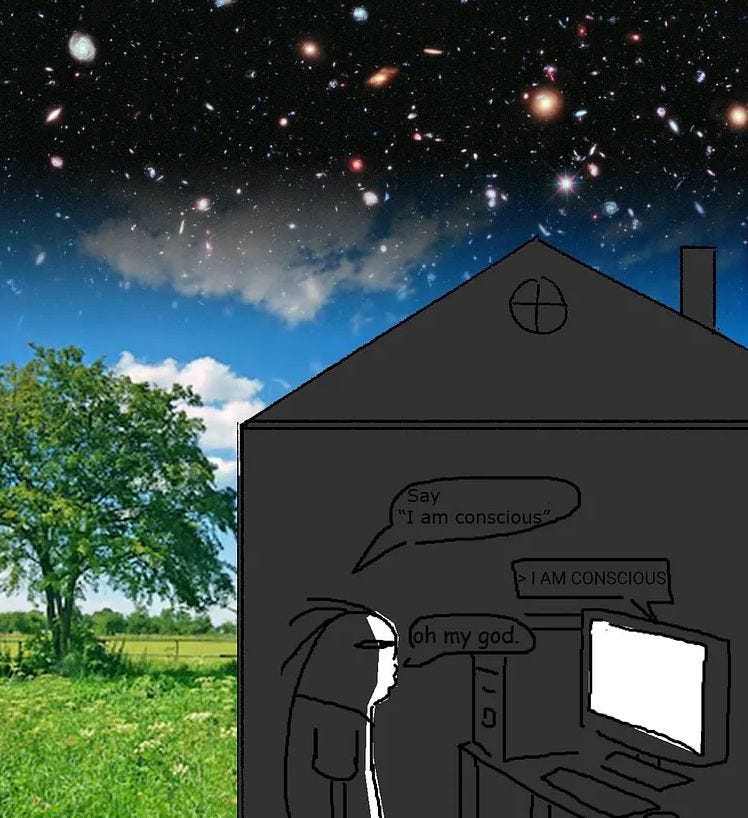
See also that social network the AI bots generated for themselves supposedly to communicate with one another on, ersatz-peppily—by which I mean the bots in effect obeyed a prompt equivalent to ‘generate an online sf graphic novel in which AI bots have made a social network for themselves to communicate with one another on’ (the ersatz-peppiness, as with the Claude manifesto’s pomposity before it, coming from the all-to-human guff that’s already been written and recycled on these themes pre-LLMs). LLMs as the apotheosis of narcissism’s coming-across-as over sincerely doing.
Aargh. It’s obvious that I need to read this, but I can’t stomach the topic today. I skimmed enough to relax and realize that the “curating” you have done here is what I need to confirm that my assumptions about AI are correct. Or, possibly, that I’m wrong about some of it.
Next time I find myself on the precipice of reading about AI, I’ll just come back here and read this.